
Quick answer
- Size it from your bill: bi-monthly KSEB units ÷ 240 ≈ the kW you need.
- Pick on-grid for most Kerala homes; choose hybrid only if power cuts are a real problem.
- Use DCR (made-in-India) panels from an empanelled vendor to qualify for up to ₹78,000 PM Surya Ghar subsidy.
- Insist on a site survey, a hot-dip galvanised structure, proper earthing and written warranties.
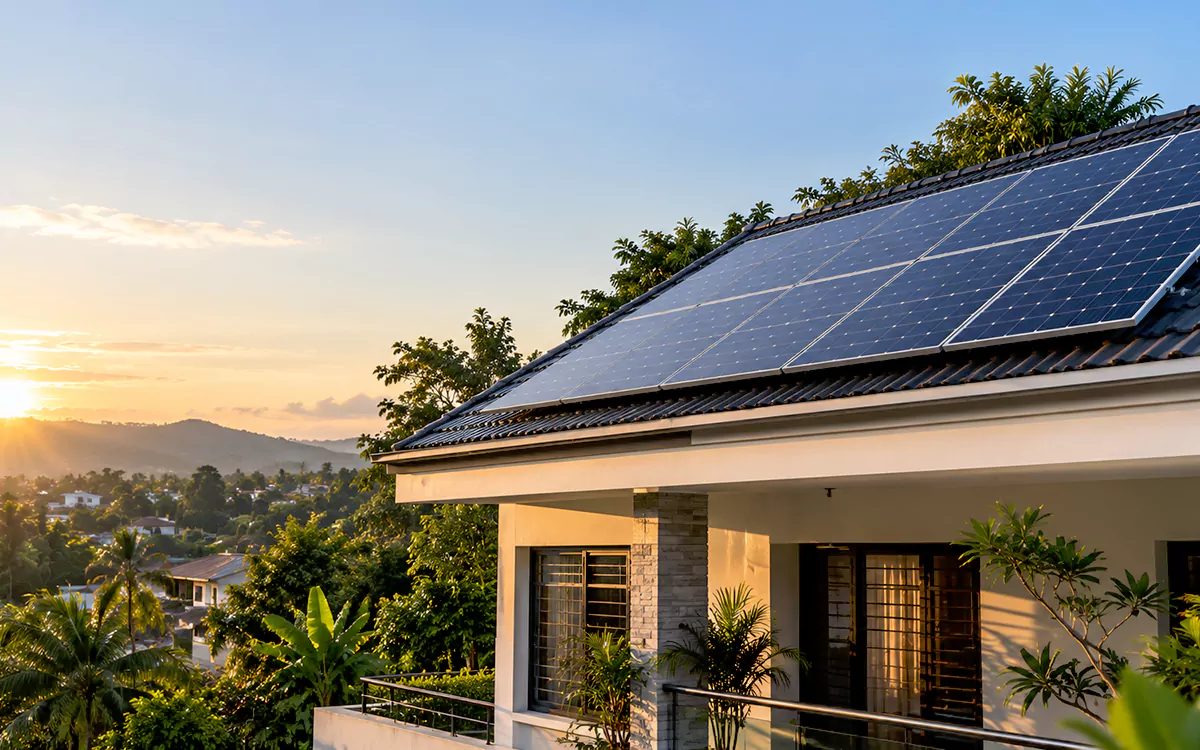
Rooftop solar is one of the best long-term investments a Kerala family can make. With rising electricity tariffs, generous central subsidy and KSEB net metering, a well-designed home solar plant typically pays for itself in about four to five years — and keeps generating for 25 years or more.
But "best" doesn't mean the biggest or the most expensive system. The best solar plant is the one that is correctly sized for your usage, suited to your roof and power situation, and installed properly so it delivers every unit it should. Here's how to get each of those decisions right.
1Start with your electricity consumption
Your KSEB bill is the most reliable starting point. In Kerala, 1 kW of well-placed solar panels generates roughly 4 units (kWh) a day, or about 120 units a month. Since KSEB bills every two months, the quick formula is:
Look at your bills for the last 6–12 months and take an average — consumption in summer (with ACs and fans running) is usually higher than in the monsoon.
| Bi-monthly KSEB units | Monthly units | Suggested system | Typical home |
|---|---|---|---|
| Up to 250 | ~125 | 1 kW | Small home, basic appliances |
| 250 – 500 | 125 – 250 | 2 kW | 2–3 BHK, fridge, TV, pump |
| 500 – 750 | 250 – 375 | 3 kW | Family home, 1 AC |
| 750 – 1,000 | 375 – 500 | 4 kW | Larger home, 2 ACs |
| 1,000 – 1,250 | 500 – 625 | 5 kW | Villa, multiple ACs, EV |
| 2,000+ | 1,000+ | 8 – 10 kW | Large villa / joint family |
From your KSEB bill to the right system size
Prefer not to calculate by hand? Try our solar calculator, or see what a typical 3 kW solar system or 5 kW solar system includes.
2Choose the right type: on-grid, off-grid or hybrid
This is the decision that affects your cost the most.
On-grid
Connected to KSEB with net metering. No batteries, lowest cost, eligible for subsidy. Excess power is exported to the grid and adjusted in your bill. Shuts down during power cuts for safety.
Hybrid
Grid-connected plus a battery bank. Gives backup during outages while still exporting surplus. Costs more because of batteries, which need replacement over the system's life.
Off-grid
Fully independent with batteries, no KSEB connection. Suitable only where grid supply is absent or very unreliable — farmhouses, estates, remote plots.
How on-grid, hybrid and off-grid systems are wired
On-grid
Recommended for most Kerala homes. Lowest cost and uses net metering, but it shuts down during a power cut.
Hybrid
Adds a battery for backup during power cuts while staying connected to the grid. Costs more because of the battery.
Off-grid
Runs entirely on panels and batteries. Suits only sites without a reliable grid supply; needs a large battery bank.
| Factor | On-grid | Hybrid | Off-grid |
|---|---|---|---|
| Upfront cost | Lowest | Higher | Highest |
| Power backup | No | Yes | Yes |
| Net metering | Yes | Yes | No |
| PM Surya Ghar subsidy | Yes | On solar portion* | No |
| Maintenance | Very low | Moderate (batteries) | Moderate (batteries) |
| Payback period | Fastest | Longer | Longest |
*Subject to scheme conditions at the time of application — we confirm eligibility during your site visit.
3Check your roof space, direction and shade
A solar plant is only as good as the sunlight it receives. Before you finalise capacity, check:
- Area: Plan for about 80–100 sq. ft of shadow-free roof per kW. A 3 kW plant needs roughly 250–300 sq. ft; a 5 kW plant about 400–500 sq. ft.
- Direction: In Kerala, south-facing panels at a 10°–15° tilt give the best year-round output. East/west layouts work too, with slightly lower generation.
- Shade: Coconut trees, water tanks, staircase rooms and neighbouring buildings can cut output sharply. Even partial shade on one panel can pull down a whole string.
- Roof type: RCC terraces are ideal. Sloped tile or sheet roofs can be used with the right mounting.
Which way should your panels face?
- South-facing: best year-round output in Kerala.
- East or west: works well, with slightly lower generation.
- North-facing: avoid where possible.
4Select quality solar panels
Panels are the heart of your plant and will be on your roof for 25+ years, so this is not the place to cut corners.
Panel technologies
Three panel technologies you will be offered
Mono PERC
Proven, efficient and widely used. A dependable choice for most homes.
TOPCon (N-type)
Higher efficiency, lower degradation and better heat performance, which suits Kerala's warm, humid climate.
Bifacial
Generates from both sides. Most useful on elevated structures over a light-coloured surface.
What to check
What to look for on the panel's label and spec sheet
Solar PV module
- Cell origin
- India (DCR)
- MNRE ALMM listed
- Yes
- Rated power (Pmax)
- 530–590 Wp
- Product warranty
- 10–12 years
- Performance warranty
- 25–30 years, linear
- DCR, made with Indian cells, is mandatory for the PM Surya Ghar subsidy.
- ALMM listing means the brand is approved by MNRE.
- Higher wattage per panel means fewer panels and less roof space.
- Two warranties: one covers the product, the other guarantees output over 25–30 years.
5Choose the right inverter
The inverter converts DC from your panels into AC for your home. It is the component most likely to need attention over the years, so choose wisely.
Reading an inverter specification
- Capacity
- Should suit your panel capacity. A 3 kW plant typically uses a 3 kW inverter.
- Phase
- Match your KSEB connection. Most homes above 5 kW use three-phase.
- Efficiency
- Look for 97% or higher.
- Monitoring
- Wi-Fi or app monitoring lets you track daily generation and spot problems early.
- Warranty and service
- At least 5–8 years, with a service network in Kerala.
How long each part is covered, compared with payback
6Don't ignore the mounting structure and safety
Kerala's heavy monsoon, strong winds and coastal salt air are tough on rooftop equipment. Many system failures we're called to fix come from cheap structures and poor wiring, not from panels.
A rooftop plant built for Kerala's weather
- Hot-dip galvanised steel or aluminium structure. Not painted mild steel, which rusts within a few years.
- Anchored firmly for high wind loads, without damaging the roof's waterproofing.
- Proper earthing to a dedicated earth pit.
- Lightning arrester, essential in the thunderstorm season.
- UV-resistant DC cables with MC4 connectors.
- ACDB and DCDB boxes with surge protection.
Not sure what size or type you need?
Our engineers will inspect your roof and review your bills — free of charge.
7Make full use of subsidy and net metering
Under the PM Surya Ghar Muft Bijli Yojana, residential consumers in Kerala receive central financial assistance directly in their bank account after the plant is commissioned and net metering is in place.
| System size | Subsidy amount |
|---|---|
| 1 kW | ₹30,000 |
| 2 kW | ₹60,000 |
| 3 kW and above | ₹78,000 (maximum) |
PM Surya Ghar central subsidy by system size
To qualify, you need an MNRE-registered vendor, DCR panels, an application on the national PM Surya Ghar portal and KSEB feasibility approval before installation. Net metering then records the units you export, so surplus solar power is set off against your consumption.
Aadithya Innovations handles the complete paperwork — portal registration, KSEB approvals, net meter installation and subsidy claim. Learn more about solar subsidy and net metering or PM Surya Ghar registration in Kerala.
How net metering works with KSEB
- Panels generate power
- Home uses solar first
- Surplus recorded as export
- Sent to the KSEB grid
- KSEB grid supplies power
- Recorded as import
- Home draws power
Getting the subsidy, step by step
- Site surveyInstaller reviews your bills, roof and shade.
- Apply onlineRegister on the national PM Surya Ghar portal with your KSEB consumer number.
- KSEB feasibilityApproval must come before installation.
- InstallationBy an MNRE-registered vendor using DCR panels.
- Net meterKSEB installs the net meter and commissions the plant.
- Subsidy paidCredited directly to your bank account.
For the full process, read our guides to PM Surya Ghar registration in Kerala and solar subsidy and net metering.
8Compare cost on value, not just price
Compare quotations line by line
Quotation: 3 kW on-grid solar plant
- Panel make and model, named (not "Tier-1 equivalent")
- Inverter make and model, named
- Structure type and height
- Net meter and KSEB fees included
- Earthing and lightning arrester included
- Free maintenance period and response time
Two quotes for the "same" 3 kW system can differ a lot, usually because of panel brand, inverter quality, structure type and what is included. If a line is missing from a quote, ask for it in writing.
The 5 kW example over 25 years
₹3,40,000system cost
7,200units generated a year
₹60,000–68,000saved on electricity a year
Spreading the cost? Compare solar financing options and check our maintenance plans before you decide.
9Choose the right installer
The same components can perform very differently depending on who designs and installs them. Before signing, make sure your installer:
- Is a registered PM Surya Ghar vendor for your area
- Does a physical site survey and shading analysis — not a quote over the phone
- Gives a detailed, itemised quotation with component brands
- Has completed projects you can visit or verify, with genuine customer reviews
- Provides workmanship warranty and an annual maintenance plan
- Has a local service team that can reach you quickly
10Common mistakes to avoid
| Avoid | Do this instead |
|---|---|
| Choosing the cheapest quote without checking component brands | Compare quotes on named panel and inverter brands, structure and inclusions |
| Under-sizing to save money now, then needing to expand later | Size from 6–12 months of bills, and plan for an EV, AC or induction cooktop |
| Ignoring shade from trees or tanks that will grow or be built | Insist on a physical site survey and shading analysis |
| Buying non-DCR panels and losing subsidy eligibility | Choose DCR panels from an ALMM-listed brand |
| Using painted MS structures that corrode in Kerala's humidity | Use a hot-dip galvanised steel or aluminium structure |
| Paying for batteries you don't really need on an on-grid connection | Pick on-grid unless power cuts are a real problem |
| Skipping cleaning and maintenance, so dust and bird droppings reduce output | Take an annual maintenance plan and clean panels regularly |
Key takeaways
- Size from your bill: bi-monthly KSEB units ÷ 240 gives the capacity in kW.
- On-grid suits most homes; choose hybrid only if power cuts are a real problem.
- Plan 80–100 sq. ft of shade-free roof per kW, ideally south-facing at a 10°–15° tilt.
- Use DCR panels from an MNRE-registered vendor to qualify for up to ₹78,000 in central subsidy.
- Compare quotes on value: component brands, structure, earthing and written warranties.
- Get KSEB feasibility approval before installation, then net metering after commissioning.
Frequently asked questions
What size solar plant do I need for my home in Kerala?
Divide your bi-monthly KSEB units by 240. A home using 480 units in two months needs roughly 2 kW; 720 units needs about 3 kW; 1,200 units needs about 5 kW. A site survey fine-tunes this for shade and roof direction.
Which is better: on-grid, off-grid or hybrid solar?
On-grid is best for most homes with a KSEB connection — it is the most affordable, qualifies for subsidy and uses net metering. Choose hybrid if frequent power cuts are a concern. Off-grid suits only locations without reliable grid supply.
How much subsidy can I get for rooftop solar?
Under PM Surya Ghar, you get ₹30,000 per kW for the first 2 kW and ₹18,000 for the third kW — up to ₹78,000 for systems of 3 kW and above, when installed by a registered vendor using DCR panels.
How much roof space do I need?
About 80–100 sq. ft of shadow-free area per kW. A 3 kW plant needs around 250–300 sq. ft and a 5 kW plant around 400–500 sq. ft.
How long does a home solar plant last?
Quality panels carry 25-year performance warranties and often last longer. Inverters typically last 8–12 years and may need one replacement during the system's life.
Does solar work during the Kerala monsoon?
Yes. Generation drops on heavily overcast days, but panels still produce power from diffused light. Sunny months more than make up for it, and annual generation is what determines your savings.
Sources and further reading
- PM Surya Ghar: Muft Bijli Yojana national portal, for subsidy amounts, eligibility and applications
- Ministry of New and Renewable Energy (MNRE), for rooftop solar guidelines and approved module lists
- Kerala State Electricity Board (KSEB), for feasibility, net metering and billing
- ANERT, Kerala's renewable energy agency
Last reviewed on 30 October 2026. Subsidy rates are set by government order; confirm current figures on the national portal before applying.
Get the right solar plant for your home
Free site inspection · Subsidy & KSEB paperwork handled · Serving Trivandrum, Kollam, Kochi & across Kerala
